
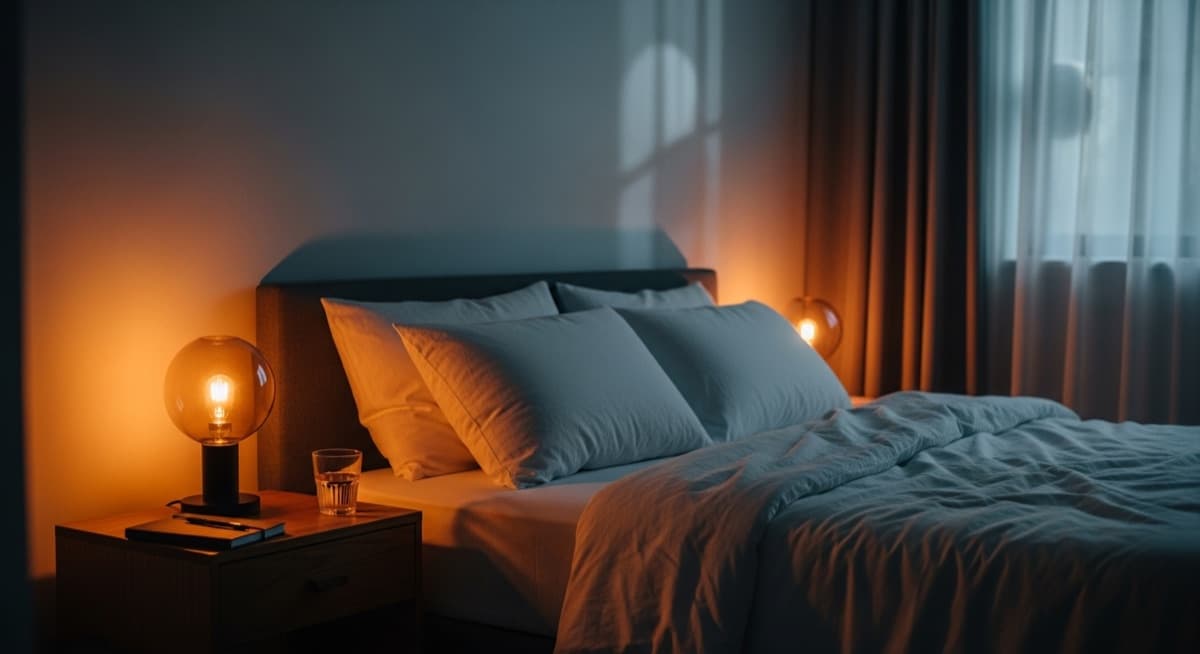
If you've ever stared at the ceiling wondering how to fall asleep fast, you're not alone — and you're not broken. Sleep onset trouble is one of the most common complaints among adults, but the fix is rarely a single hack. Here are 12 science-backed strategies, ranked from immediate to habit-level, so you can start using them tonight.
Why Falling Asleep Feels Hard (The Biology)
Sleep isn't a switch you flip — it's a biological gradient. Your core body temperature needs to drop roughly 1–2°F, cortisol has to fall, and adenosine (a sleepiness chemical that builds throughout the day) must accumulate enough to override your arousal system.
Two things most commonly block that cascade:
- Elevated core temperature from exercise, hot rooms, or digestion
- Elevated cortisol from stress, blue light exposure, or late caffeine
Fix those two, and most other tricks fall into place.
How to Fall Asleep Fast: Immediate Techniques (Tonight)
These work within minutes to shift your nervous system toward sleep.
1. The 4-7-8 Breathing Method
Developed by Dr. Andrew Weil based on pranayama breath control, this pattern activates your parasympathetic nervous system — your "rest and digest" mode.
- Exhale completely through your mouth
- Inhale through your nose for 4 counts
- Hold for 7 counts
- Exhale through your mouth for 8 counts
- Repeat 4 cycles
Most people feel noticeably calmer after two cycles. It works because the extended exhale stimulates the vagus nerve, which directly lowers heart rate.
2. Progressive Muscle Relaxation (PMR)
Start at your feet. Tense each muscle group for 5 seconds, then release for 30 seconds and notice the contrast.
Order: toes → calves → thighs → abdomen → hands → arms → shoulders → face
The release phase triggers a parasympathetic rebound that can shave significant time off sleep onset. It's especially effective for people who carry physical tension from a desk job.
3. The Military Sleep Method
Used reportedly to help pilots fall asleep in under 2 minutes even in stressful environments:
- Relax your face muscles — jaw, tongue, eyes
- Drop your shoulders, then let your hands fall
- Exhale and relax your chest
- Relax your legs top-to-bottom
- Clear your mind for 10 seconds by imagining a still lake or dark room
It takes practice — most people see results within a few weeks of consistent nightly use.
4. Drop Your Core Temperature
Your body *must* cool to initiate sleep. Speed this up:
- Take a warm shower 60–90 minutes before bed — counterintuitively, this draws heat to the skin surface and accelerates core cooling afterward
- Keep your bedroom between 65–68°F (18–20°C)
- Use breathable cotton or bamboo bedding
Pro tip: If you sleep hot, run your wrists under cool water for 30 seconds before getting into bed. Blood vessels there are close to the surface and act as a fast-cooling radiator.
Optimize Your Evening Routine
5. Cut Caffeine by Early Afternoon
Caffeine's half-life is roughly 5–6 hours in most people, meaning a 3 PM coffee still has half its stimulant effect at 9 PM. Genetic variants (specifically the CYP1A2 enzyme) make some people metabolize caffeine significantly slower — if you're a "slow metabolizer," even noon coffee can disrupt sleep.
Practical rule: last caffeine by 1–2 PM if you want to sleep by 10–11 PM.
6. Dim Lights and Go Amber 90 Minutes Before Bed
Blue-wavelength light (from phones, laptops, overhead LEDs) suppresses melatonin production. Switching to warm amber lighting or using blue-light-blocking glasses in the 90-minute wind-down window helps your brain start its melatonin ramp.
- Use your phone's "Night Shift" / "Night Mode"
- Dim overhead lights or switch to a lamp
- Avoid screens in bed where possible — the bed should be a cue for sleep, not content
7. Time Your Last Meal Strategically
Digestion raises core body temperature and keeps your metabolism active — both fight sleep onset. A heavy meal within 2 hours of bed consistently disrupts sleep quality and can worsen acid reflux symptoms.
If you're hungry close to bedtime, small snacks with sleep-friendly nutrients work better than large meals. Foods that naturally contain tryptophan (the amino acid precursor to serotonin and melatonin) and magnesium tend to be the best choices:
- A small bowl of oatmeal with a drizzle of honey
- A handful of almonds (~23 almonds provide ~76mg magnesium)
- A banana (potassium + magnesium + small tryptophan amount)
- A small portion of cottage cheese (~25g protein, tryptophan-rich)
- Tart cherry juice (naturally contains small amounts of melatonin)
Tracking what you eat in the evenings — and noticing patterns in your sleep quality — is something many people find genuinely eye-opening. The LifeBar AI app makes that easy: snap your dinner plate, get the full breakdown instantly, and see if evening carb-to-protein ratios are quietly wrecking your rest.
Address the Root Cause: A Racing Mind
Most chronic sleep-onset trouble isn't physical — it's cognitive. Your brain rehearses tomorrow's tasks, replays today's awkward conversation, or spins on unresolved worries.
8. The "Cognitive Shuffle" Technique
Developed by sleep researcher Dr. Luc Beaulieu-Prévost, the cognitive shuffle works by making your thoughts random and non-threatening — mimicking the hypnagogic imagery your brain naturally produces just before sleep.
How to do it:
- Pick a neutral word (e.g., "BREAD")
- Visualize random images for each letter: Balloon, Rocket, Elephant, Anchor, Dragon
- Let each image get weird and drift before moving on
The randomness short-circuits the narrative, problem-solving part of your brain, which is what keeps you awake.
9. Write a Tomorrow List (The "Offload")
A well-studied technique: spend 5 minutes before bed writing out everything you need to do tomorrow. Not a worry journal — a *task list*. Research suggests this reduces pre-sleep cognitive arousal because it signals to your brain that those tasks are captured and don't need active monitoring.
Keep a small notepad on your nightstand. Old-school analog beats phone (no screen).
10. Body Scan Meditation
A gentler alternative to PMR — instead of tensing and releasing, you simply direct attention through each body part from feet to head, noticing sensation without judgment. Apps like Calm or Insight Timer have free guided versions, but you don't need them; just slow attention works.
Habit-Level Fixes (Week+ Timeline)
11. Anchor Your Wake Time — Not Your Bedtime
This is the single highest-leverage long-term fix most sleep specialists recommend. Your circadian rhythm is anchored by wake time, not bedtime. Set a consistent wake alarm 7 days a week (even weekends), and your sleep pressure will naturally align your bedtime.
The temptation to "catch up" on weekends by sleeping in is real but counterproductive — it's called social jet lag, and it consistently predicts worse sleep onset the following week.
12. Get Bright Light in the Morning
Morning light — ideally sunlight within 30–60 minutes of waking — sets your circadian clock by suppressing residual melatonin and anchoring your cortisol peak to early morning (which means it falls off appropriately by evening).
Even on cloudy days, outdoor light is dramatically brighter than indoor lighting. Just 10 minutes outside is enough. This one habit has cascading effects on every other sleep metric.
When to Consider Supplements
Melatonin is widely misunderstood. It's not a sedative — it's a timing signal. Low doses (0.5–1mg) taken 30–60 minutes before desired sleep time are what research supports for shifting your clock. High doses (5–10mg) sold at pharmacies don't accelerate sleep significantly and can cause grogginess.
Magnesium glycinate is often recommended for its calming effects and is generally well-tolerated, but evidence for sleep specifically is still emerging.
If sleep trouble is persistent or severe, always consult a doctor or sleep specialist before adding supplements or making major lifestyle changes. Chronic insomnia can have underlying causes — sleep apnea, anxiety disorders, thyroid issues — that supplements won't fix.
For more evidence-based wellness reads, browse the LifeBar AI blog.
Frequently Asked Questions
How long should it take to fall asleep normally?
Most sleep researchers consider a sleep onset latency of 10–20 minutes to be healthy. Falling asleep instantly (under 5 minutes) can actually be a sign of significant sleep deprivation. Taking longer than 30 minutes regularly suggests something in your pre-sleep routine or environment needs adjustment.
Does melatonin actually help you fall asleep faster?
It depends on why you're struggling. Melatonin is most effective for circadian-rhythm-related issues — jet lag, shift work, or delayed sleep phase (natural night-owls who can't fall asleep until very late). For general stress-related sleep trouble, behavioral techniques like PMR and breathing exercises tend to outperform melatonin.
Can what I eat affect how fast I fall asleep?
Yes, meaningfully. High-glycemic meals close to bedtime, alcohol (which fragments sleep architecture even if it aids initial drowsiness), and large portions that require extended digestion all interfere with sleep onset and quality. Conversely, tryptophan-rich, magnesium-containing evening snacks have modest evidence for supporting sleep.
Is it okay to use your phone in bed if you use night mode?
Night mode reduces — but doesn't eliminate — blue light exposure. The bigger issue is cognitive arousal: scrolling social media or checking email keeps your problem-solving brain active. The recommendation from most sleep specialists is to remove screens from the bed entirely, not just filter them.
What's the fastest way to fall asleep if I wake up at 3 AM?
Avoid checking the clock (it increases anxiety). Use 4-7-8 breathing or the cognitive shuffle to break the thought spiral. If you've been awake for more than 20 minutes, sleep restriction therapy recommends getting out of bed and doing something calm (dim light, no screens) until you feel sleepy again — staying in bed awake weakens the psychological association between bed and sleep.
The Bottom Line: How to Fall Asleep Fast Tonight
How to fall asleep fast isn't about a single trick — it's a stack: cool room, dimmed lights, no caffeine after early afternoon, a calmed mind, and consistent wake times. Pick 2–3 of these tonight, and layer in the rest over the coming week.
Sleep and nutrition are deeply connected — poor sleep drives hunger hormones up and willpower down, making it harder to eat well the next day. If you want to close that loop, LifeBar AI gives you instant visibility into your nutrition so you can make evening choices that support recovery, not just taste good.
Start there. Sleep better. Feel the difference in everything else.