
If you deal with chronic tightness or nagging aches, targeted lower back exercises are one of the most effective tools you have — both for pain relief and long-term strength. This guide walks you through 10 evidence-based moves, how to program them, and what to know before you start.
Why Your Lower Back Hurts (And Why Movement Is the Fix)
The lumbar spine carries the bulk of your body's load all day. Sitting compresses the discs, weak glutes shift stress onto the spine, and tight hip flexors pull the pelvis out of alignment. The result: chronic tension, spasms, or that dull ache at the end of a long day.
The counterintuitive truth is that rest alone rarely fixes it. Research consistently shows that graded movement — progressive, pain-guided exercise — outperforms bed rest for most non-specific lower back pain. The goal isn't just flexibility; it's building the deep stabilizing muscles that protect the spine under load.
Key muscles to target:
- Multifidus — the deep spinal stabilizer most people never train
- Glutes (max + med) — the primary load-transferring muscles for the lumbar region
- Transverse abdominis — your internal "corset" that braces the spine
- Hip flexors — tight ones drag on the lumbar vertebrae; they need stretching, not strengthening
Pro tip: Train the lower back every other day, not daily. The deep stabilizers need 48 hours to recover, and overtraining them is exactly what causes setbacks. Consistency over two weeks beats intensity in one session.
Before You Start: A Few Non-Negotiables
- Sharp, shooting, or radiating pain (down the leg = possible nerve involvement) → see a doctor before exercising.
- Pain above a 4/10 during a move → skip or regress it; pain is a stop signal, not a push-through signal.
- No diagnosis yet? A physio can rule out disc herniation, stenosis, or structural issues that change which exercises are safe.
- Consult a healthcare provider before beginning any new exercise program, especially if you have an existing back condition or recent injury.
10 Lower Back Exercises to Relieve Pain and Build Strength
1. Cat-Cow Stretch
Why it works: Mobilizes every lumbar segment, warms up the spine before loaded work, and decompresses discs after prolonged sitting.
How to do it:
- Start on all fours, wrists under shoulders, knees under hips
- Cow: Inhale, drop the belly toward the floor, lift the head and tailbone
- Cat: Exhale, round the spine toward the ceiling, tuck the chin and pelvis
- Move slowly and breathe; the breath drives the motion
Sets/reps: 2 sets × 10 full cycles
2. Child's Pose
Why it works: Passively lengthens the lumbar erectors and decompresses the facet joints — great as a warm-up opener or active recovery between sets.
How to do it:
- Kneel, sit hips toward heels, extend arms forward on the floor
- Let gravity sink the chest; breathe into your lower back
- Hold 30–60 seconds; use a pillow under the hips if painful
Sets/reps: 2–3 holds of 45 seconds
3. Knee-to-Chest Stretch
Why it works: Directly targets lumbar flexion range and releases the hip flexors' pull on the lumbar spine.
How to do it:
- Lie on your back, pull one knee gently to your chest using both hands
- Keep the opposite leg flat (or bent if needed)
- Hold 20–30 seconds per side; avoid yanking the knee
Sets/reps: 2 × 30 seconds each side
4. Pelvic Tilts
Why it works: Retrains the transverse abdominis and multifidus to fire together — foundational neuromuscular work before loading.
How to do it:
- Lie on your back, knees bent, feet flat
- Gently flatten your lower back against the floor by tightening your abs and slightly tucking the pelvis — no glute squeeze needed
- Hold 5 seconds, release completely
Sets/reps: 3 × 15 reps, 5-second holds
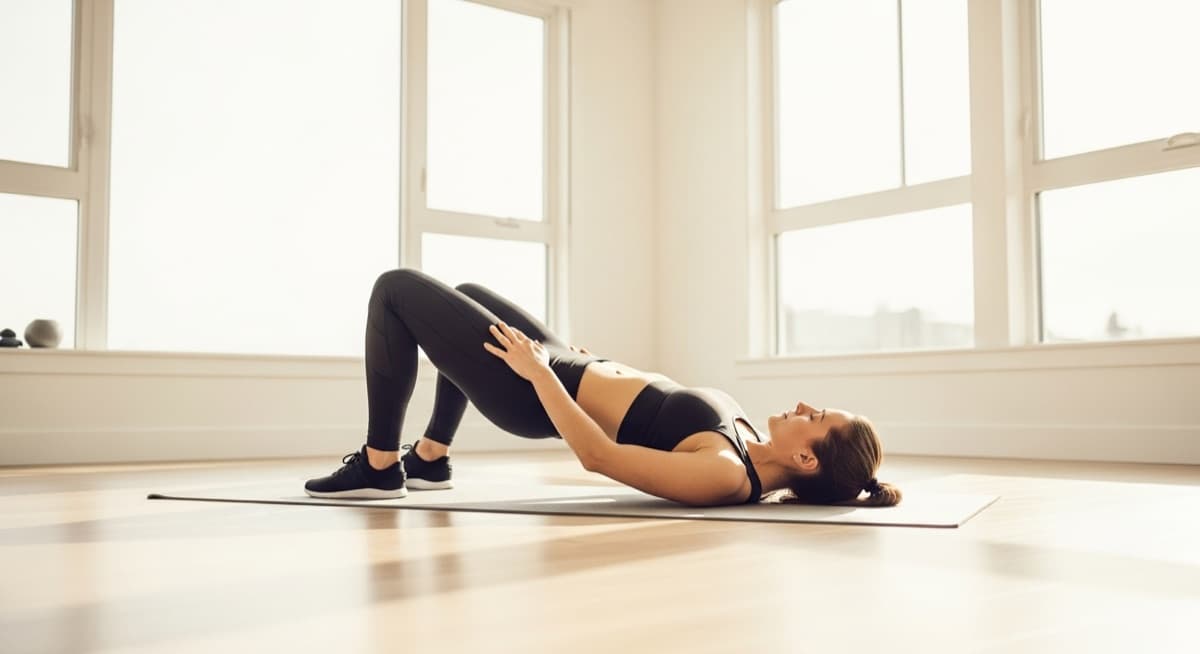
5. Glute Bridge
Why it works: Activates the glute max, reduces lumbar shear, and teaches proper hip hinge mechanics — arguably the single most important lower back exercise for most people.
How to do it:
- Lie on your back, knees bent, feet hip-width, flat on the floor
- Drive through the heels, squeeze glutes, lift hips until the body forms a straight line from knees to shoulders
- Do not hyperextend the lower back at the top — think "ribs down"
- Lower slowly (3 counts down)
Sets/reps: 3 × 12–15 reps; progress to single-leg bridge when comfortable
6. Bird Dog
Why it works: Trains anti-rotation stability of the lumbar spine under load — heavy research support for this move in rehab settings.
How to do it:
- Start on all fours, spine neutral (imagine a glass of water on your back)
- Extend opposite arm and leg simultaneously, hold 2 seconds at full extension
- Return slowly; don't let the hips rotate or the lower back collapse
- Keep the core braced throughout
Sets/reps: 3 × 10 reps per side
7. Dead Bug
Why it works: Challenges the deep stabilizers while the spine stays flat — harder than it looks, and far safer than crunches for back pain sufferers.
How to do it:
- Lie on your back, arms extended toward the ceiling, hips and knees at 90°
- Press your lower back into the floor — maintain this throughout
- Slowly lower one arm overhead and the opposite leg toward the floor simultaneously
- Return and switch sides; breathe out on the lowering phase
Sets/reps: 3 × 8 reps per side
8. Superman Hold
Why it works: Directly strengthens the lumbar erectors and glutes with bodyweight resistance — no equipment required.
How to do it:
- Lie face down, arms extended overhead, forehead on the floor
- Simultaneously lift arms, chest, and legs off the floor
- Squeeze the glutes, keep the neck neutral (don't crane upward)
- Hold 2–3 seconds at the top; lower with control
Sets/reps: 3 × 10 reps; progress by adding a pause
9. Reverse Hyperextension (Floor Version)
Why it works: Isolates the glutes and lumbar erectors without spinal compression — excellent for building posterior chain strength pain-free.
How to do it:
- Lie face down with hips at the edge of a bench or on the floor
- With legs together and straight, lift them toward the ceiling using glute and lower back contraction
- Avoid momentum; the movement should be controlled
- Lower slowly
Sets/reps: 3 × 12 reps
10. Wall Sit with Posterior Pelvic Tilt
Why it works: Builds quad and hip endurance while teaching lumbar neutral position — surprisingly effective for reducing the anterior pelvic tilt pattern driving many back complaints.
How to do it:
- Stand with back flat against the wall, feet 18–24 inches out
- Slide down until thighs are parallel to the floor (or as low as comfortable)
- Actively press the lower back into the wall — no arch
- Hold and breathe
Sets/reps: 3 × 30–45 seconds
How to Program These Lower Back Exercises
You don't need to do all 10 every session. Here's a simple structure:
3x/week routine (alternating days):
- Warm-up: Cat-Cow + Child's Pose + Knee-to-Chest (5–7 min)
- Stability block: Pelvic Tilts → Bird Dog → Dead Bug
- Strength block: Glute Bridge → Superman → Reverse Hyperextension
- Cool-down: Child's Pose + Wall Sit
Progress by adding reps or introducing resistance (resistance band around the hips for bridges, ankle weights for supermans) after 2–3 weeks of consistent training.
Nutrition's Role in Lower Back Recovery
Muscle repair and spinal disc health both depend on nutrients most people undertrack:
- Protein (1.6–2.2g per kg of bodyweight daily): Muscle rebuilding after every session — this includes the small stabilizers that rarely get attention
- Anti-inflammatory foods: Fatty fish (omega-3s), berries, leafy greens, and olive oil help reduce systemic inflammation that amplifies pain perception
- Magnesium: Found in nuts, seeds, and legumes; involved in muscle relaxation and nerve function
- Hydration: Spinal discs are ~80% water — chronic dehydration accelerates disc degeneration
Tracking your actual macro and micronutrient intake is harder than it sounds. Tools like LifeBar AI let you snap a photo of any meal and instantly see the protein, fat, carbs, and key nutrients — no manual logging required. If you want to calculate your personal protein target first, the macro calculator is a good starting point.
Frequently Asked Questions
How long does it take for lower back exercises to work?
Most people notice meaningful pain reduction within 2–4 weeks of consistent training (3× per week). Structural strength improvements — the kind that prevent recurrence — take closer to 8–12 weeks. The key variable is consistency, not intensity.
Should I exercise when my lower back is actively flaring?
Mild discomfort (1–3/10): yes, gentle mobility work like Cat-Cow and Child's Pose is usually safe and helpful. Acute pain spike or spasm (5+/10): rest 1–2 days, then resume at reduced intensity. Sharp or radiating pain: stop and see a doctor.
Are lower back exercises safe for herniated discs?
Many are, but the specifics depend on the herniation level and direction. Flexion-based moves (knee-to-chest, Child's Pose) can worsen posterior herniations. Extension moves (Superman) are often prescribed for those cases. Get cleared by a physio first — this is not a situation for guesswork.
Can I do these exercises every day?
Mobility work (Cat-Cow, stretches) can be done daily. Strengthening moves (Bird Dog, Dead Bug, Glute Bridge) need 48 hours of recovery between sessions — that's when the adaptation actually happens.
Is lower back pain ever a sign of something serious?
Occasionally. Red flags include pain that's severe and constant, wakes you from sleep, comes with bladder/bowel changes, follows a fall or trauma, or is accompanied by unexplained weight loss. Any of these warrant a doctor visit rather than a home exercise program.
The Bottom Line
Consistent, targeted lower back exercises — mobility first, stability second, strength third — are the most reliable path to a pain-free, resilient spine. Pick 4–5 moves from this list, commit to three sessions per week, and track your progress. Recovery stalls when nutrition lags behind training, so keep protein and anti-inflammatory foods dialed in alongside your workouts.
If you want to make sure your meals are actually fueling your recovery, LifeBar AI takes the guesswork out of nutrition tracking — just photograph your plate and get an instant macro breakdown. Small, trackable habits compound fast.