
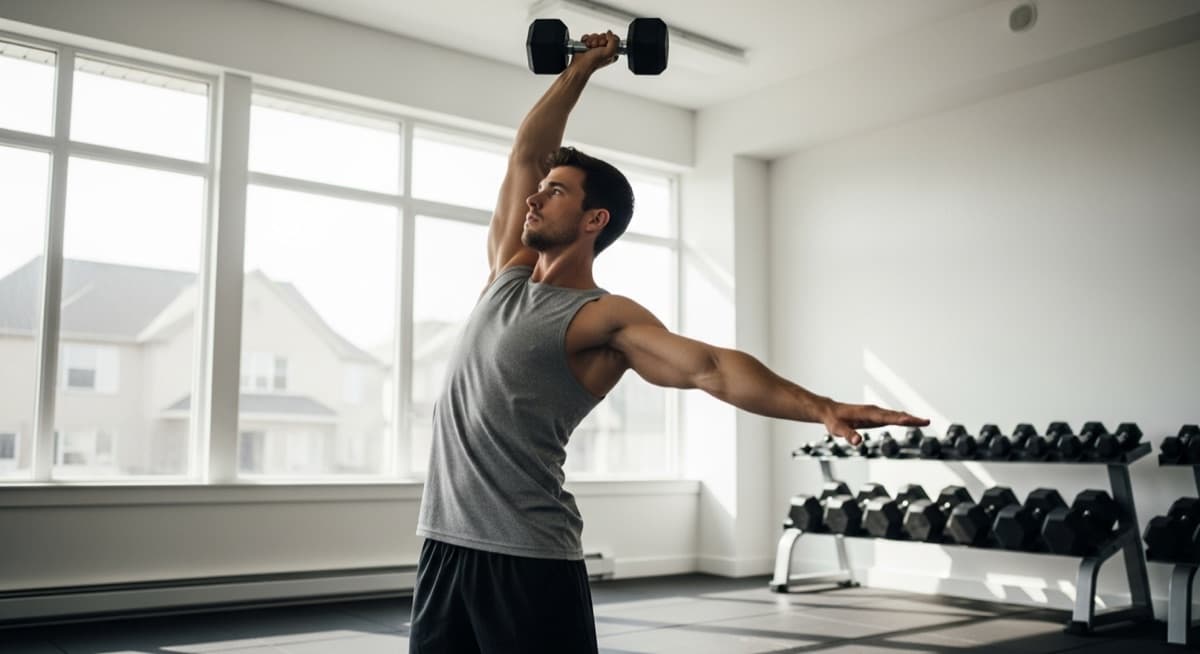
If you want bigger, stronger arms, tricep dumbbell exercises are some of the most effective moves you can do — whether you're training at home or in the gym. Your triceps make up roughly two-thirds of your upper arm mass, which means neglecting them is leaving serious size on the table. This guide covers the 10 best dumbbell moves for your triceps, complete with sets, reps, and form cues so you can train smarter starting today.
Why Your Triceps Deserve More Attention
Most people obsess over biceps, but the triceps — the three-headed muscle running along the back of your upper arm — are the bigger muscle group by a wide margin. Training them well pays off in arm size, pressing strength, and overall upper body performance.
The three heads each respond to slightly different angles:
- Long head — runs down the back of the arm; fully loaded only during overhead movements
- Lateral head — the outer head that creates the horseshoe shape; hit hard by pressing motions
- Medial head — the deepest head; active in virtually every tricep movement
To maximize development, you need a mix of overhead and pressing exercises. Dumbbells are ideal because they allow a full range of motion, expose left-right imbalances early, and work just as well on your living room floor as on a gym bench.
What to Know Before You Start
- Warm up your elbows. Do 5 minutes of light cardio and some arm circles before loading up — cold elbows are an injury waiting to happen.
- Elbow health is non-negotiable. Sharp elbow pain during any exercise means stop, drop the weight, and reassess your form before continuing.
- Progressive overload is the engine. Add a rep or a small amount of weight each week. That's how triceps grow.
- Rest periods: 60–90 seconds between sets for hypertrophy; 2–3 minutes if you're chasing strength.
As with any new training program, consult a doctor or certified personal trainer before adding heavy loading if you have existing elbow, shoulder, or wrist issues.
The 10 Best Tricep Dumbbell Exercises
1. Overhead Tricep Extension
Best for: Long head mass, maximum stretch
- Hold one dumbbell with both hands, gripping the inner plate, arms fully extended overhead
- Keeping your elbows close to your ears, slowly lower the weight behind your head until you feel a deep stretch through the back of the arm
- Drive the weight back to the start — don't let your elbows flare wide
Sets/Reps: 3–4 sets of 10–12 reps
The overhead position is the only way to fully lengthen the long head. This single exercise does more for tricep mass than most isolation moves combined.
2. Single-Arm Overhead Tricep Extension
Best for: Fixing imbalances, focused isolation
- Hold one dumbbell in one hand overhead and use your free hand to gently support the working elbow
- Lower the weight behind your head, then press back up with control
- Keep your torso upright — resist the urge to lean hard to one side
Sets/Reps: 3 sets of 12 reps per arm
If one tricep is lagging behind the other, you'll feel it immediately here. Fix imbalances now before they start showing up in your bench press numbers.
3. Tricep Kickback
Best for: Lateral and medial head, peak contraction
- Hinge forward at the hips to roughly 45 degrees, holding a dumbbell in one hand
- Pin your upper arm parallel to the floor — it should not move during the rep
- Extend your forearm back until your arm is completely straight, then squeeze hard at the top for a full second
- Lower slowly — take about 2 seconds on the way down
Sets/Reps: 3 sets of 12–15 reps per arm
The squeeze at the top is everything. Use lighter weight than you expect and feel the muscle actually work.
4. Incline Tricep Kickback
Best for: Strict form, removing momentum
- Set a bench to a 30–45 degree incline and lie face-down on it, one dumbbell in each hand
- With your upper arms pinned to your sides, extend both arms back simultaneously
- Lower with control and repeat
Sets/Reps: 3 sets of 12–15 reps
The incline locks your torso in place so you can't hinge or rock. The result is pure tricep work — no body English allowed.
5. Close-Grip Dumbbell Press
Best for: Overall strength, compound loading
- Lie on a bench or the floor, holding two dumbbells with palms facing each other (neutral grip)
- Press both dumbbells up while keeping them close together and your elbows tucked tight against your sides
- Lower slowly until the weights reach chest height, then press again
Sets/Reps: 3–4 sets of 8–10 reps
This is the dumbbell equivalent of the barbell close-grip bench press. It's a compound push that lets you handle more weight than isolation moves, making it essential for building raw tricep strength.
6. Dumbbell Skull Crusher (Lying Tricep Extension)
Best for: All three heads, strength and size
- Lie flat on a bench or the floor, holding two dumbbells with arms extended directly over your chest
- Keeping your upper arms vertical, slowly bend your elbows and lower the dumbbells toward your temples
- Extend back to the start without aggressively locking out your elbows
Sets/Reps: 3–4 sets of 10–12 reps
Pro tip: Let your upper arms drift about 10–15 degrees back from vertical as you lower the weight. This keeps constant tension on the tricep through the full range rather than loading the elbow joint at the bottom.
7. Tate Press
Best for: Lateral head, short-range contraction pump
- Lie flat on a bench holding two dumbbells over your chest — elbows flared wide, dumbbell tips pointing down toward the floor
- Bend your elbows to lower the weights toward your lower chest, keeping the elbows wide
- Press back up by driving the elbows together and extending
Sets/Reps: 3 sets of 10–12 reps
The Tate press is criminally underrated. It loads the tricep in a shortened position and delivers a strong pump in the lateral head that pressing and kickbacks rarely match.
8. Cross-Body Tricep Extension
Best for: Long head, unique loading angle
- Stand or sit upright, holding one dumbbell in your right hand extended overhead
- As you lower the weight behind your head, let your elbow cross slightly in front of your face toward your left shoulder
- Press back up and repeat
Sets/Reps: 3 sets of 12 reps per arm
The cross-body angle puts the long head under a slightly different line of pull than a standard overhead extension, giving you a fresh stimulus without adding a whole new exercise category.
9. Dumbbell Floor Press (Tricep Focus)
Best for: Home training, lockout strength, shoulder-friendly pressing
- Lie on the floor with knees bent, holding dumbbells at chest height, elbows at roughly 45 degrees from your torso
- Press up toward the ceiling, pausing momentarily when your upper arms lightly touch the floor — don't rest, just touch
- Focus your effort on the top two-thirds of the press where the triceps dominate
Sets/Reps: 3–4 sets of 10–12 reps
No bench? No problem. The floor limits range of motion, which reduces shoulder stress and shifts work squarely onto the triceps. One of the best home tricep moves in the list.
10. JM Press (Dumbbell Version)
Best for: Strength, powerlifting carryover, lockout power
- Lie on a bench holding dumbbells over your chest with a neutral grip
- Lower the weights by simultaneously bending your elbows AND letting them drift slightly toward your head — it's a hybrid between a skull crusher and a close-grip press
- Press back up along the same diagonal path
Sets/Reps: 3 sets of 8–10 reps
The JM press is a staple among powerlifters for building the lockout strength needed for heavy bench work. It's more technical than the other exercises here — start light and dial in the groove before adding load.
Sample Tricep Dumbbell Exercise Routines
Beginner (Home or Gym, ~25 min)
- Overhead Tricep Extension — 3 x 12
- Tricep Kickback — 3 x 12 per arm
- Dumbbell Floor Press — 3 x 10
Intermediate (Gym, ~35 min)
- Close-Grip Dumbbell Press — 4 x 8
- Dumbbell Skull Crusher — 3 x 10
- Overhead Tricep Extension — 3 x 12
- Incline Tricep Kickback — 3 x 15
Advanced (Gym, ~45 min)
- JM Press — 4 x 8
- Tate Press — 3 x 10
- Single-Arm Overhead Extension — 3 x 12 per arm
- Cross-Body Extension — 3 x 12 per arm
- Incline Kickback — 3 x 15
Rest 60–90 seconds between sets for all three routines.
Common Mistakes with Tricep Dumbbell Exercises
- Going too heavy too soon. Flaring elbows, swinging torso, and cut-short reps all signal the weight is too heavy. Drop it and feel the muscle actually contract through the full range.
- Skipping the stretch. Half-repping extensions and skull crushers shortchanges the long head, which only gets fully loaded at the bottom of the movement. Full range, every rep.
- Ignoring the long head entirely. If your tricep training is only kickbacks and presses, the long head never gets properly targeted. Overhead work is non-negotiable for complete development.
- Not tracking your progress. You can't outwork what you can't measure. Log your weights and reps each session so you know when to push the load up. If you're eating to build muscle, your protein intake matters just as much as your workout — apps like LifeBar AI make it easy to track both without the spreadsheet headache.
Frequently Asked Questions
How many times per week should I train triceps with dumbbells?
Two dedicated tricep sessions per week is the sweet spot for most people. If your triceps are already getting significant work during chest or shoulder pressing days, one direct arm session on top of that is often enough. More volume than that requires solid recovery — sleep, protein, and rest days.
Can I actually build big triceps with dumbbells only?
Yes, especially as a beginner or intermediate. Dumbbells allow a full range of motion and enough progressive loading to drive real size and strength gains. As you become more advanced, cables or a barbell can help push past plateaus, but they're not required to build impressive arms.
What weight should I start with?
Start lighter than your ego wants. For overhead extensions and skull crushers, 10–20 lb dumbbells are a solid starting range for most people. For kickbacks, 8–15 lbs. Only move the weight up when you can complete all reps with clean, controlled form — no swinging, no half reps.
How do I know if I'm actually working my triceps?
You should feel a stretch in the back of your arm during the lowering phase and a strong contraction at the top of each rep. If you feel the effort mostly in your shoulders, wrists, or feel nothing at all, slow down, reduce the weight, and focus on the mind-muscle connection before adding load.
Should I train biceps and triceps on the same day?
Yes — pairing them is a proven and time-efficient approach. They're opposing muscle groups and don't compete for resources in the same session. Supersetting a set of curls with a tricep move is one of the fastest ways to get through an arm day without sacrificing quality.
The Bottom Line
Your triceps are the key to bigger arms, stronger presses, and better athletic performance. The good news: with the right tricep dumbbell exercises — overhead extensions for long head mass, pressing moves for strength, and kickbacks for peak contraction — you can build them effectively at home or in the gym with nothing more than a pair of dumbbells.
Pick 3–4 exercises from this list, train them twice a week, and apply progressive overload consistently. Results will follow within weeks.
To make sure your nutrition backs up the work you're putting in, use our macro calculator to dial in your protein targets — muscle doesn't grow in a calorie vacuum. And when you're ready to take your nutrition tracking off autopilot, LifeBar AI lets you snap a photo of any meal and get an instant breakdown of macros and nutrients, so fueling your gains becomes as simple as pointing your camera.
Show your arms what consistent work actually looks like.